Saturday, 26 May 2018

Shear delight

Monday 14th May 2018
Shearing Day
Next to pantomime, sheep shearing is just about as seasonal a job as you could get.
You don't want it done too early or the sheep will feel the cold. But too far into early summer and they get too hot. More importantly fly strike becomes a real problem.
Luckily we realised early enough that our usual shearer had become unavailable. He got himself a job in Australia so, quite unreasonably I thought, would not be able to shear my sheep this year.
Fortunately we were in time to piggy back on someone else's arrangements.

Last year the sheep were not shorn until the second week of June. They were hot and were in various states of self-shearing. There were clumps of wool all over the paddocks.
So this year we managed to get the job done a few weeks earlier. The lambs came down with the adults, but they don't get sheared. Two weeks later and we might have kept them up this end to wean them.

Shetlands are small, so shearing is quick, but they can be a little feisty at times. One of the ewes gave the shearer's arm a good kick! I was very happy with the shearer we used. He was quick and efficient, but just as importantly his communication was good. It is always a worry that your shearer won't turn up after you have taken time off work and gone to the effort of penning the sheep. It's not easy to book a replacement in a hurry.

All penned up ready for shearing.
I put them in a large pen until the shearer arrives, then narrow it down.
That's Rambo on the floor getting a hair cut. He was calmer this year than usual.
All done and heading back down to the sheep field.
With the shearing done, fly strike is much less of a worry. The shearer offered to apply a spray-on fly strike preventative too, which works out much cheaper and easier than if we did it ourselves. This chemical can be used at shearing, unlike some of the others. The chemical is pretty strong stuff and means the sheep are not organic, but if you have seen fly strike in action you wouldn't want to be pussy footing around with garlic and essential oils! We asked the shearer to check their feet too and trim where necessary. Again, better to do it all at once.
One reason I like having the shearer round is that it gives a good chance for someone who knows what they are doing to give the flock a quick look over. I do check on the health of the Shetlands every day and spend quite a bit of time with the in the field, but apart from Rambo and the lambs I rarely get very close to the others to inspect them closely.

Shearing made it obvious that last year's efforts at castration were only partly successful. Two of the ram lambs will need to be kept away from the females later in the year - it is a good job they will be going off to the butcher before then.
One which for some reason I had fixed in my head as a young ewe is actually a male!! I had begun to have my suspicions. This is quite useful, since a wether (castrated male) is good company for the ram when he needs to be separated from the ewes. Come August they will be coming into season but we don't want Rambo to service the ewes until early November so that we can aim for lambing to be during school Easter holidays. This year we will also have to separate the one female lamb. She can go with the wether while Rambo is in with the older ewes.

It was good to ascertain the condition of the ewes too, especially Ewe 00004 who nearly died earlier in the year. She is still skinny but not disastrously so. Hopefully she will begin to put weight on again quite soon.

Happily settled back in to a new strip of pasture.
There was one other surprise while the sheep were being sheared. The ewe which did not give birth this year looks as though her udders may be swelling up. If so, we will have a very late lamb.We'll see what happens.

Wednesday, 23 May 2018

Going For A Song

Tuesday 15th May 2018
Going For A Song
Last night I WhatsApp'ed my birding mates... Test week. I am ****ed if something turns up this week.

To translate for those that don't know me outside of smallholding, I am a part-time primary school teacher. Part of my job is to prepare and support Year 6 children for their tests, for the poor things have a series of impossible hoops to jump through. It is a result of endless educational 'improvements' so that successive governments can either lambast teachers for not doing their jobs properly or boast about how good they are since they have successfully taken the child out of Britain's children.

The second part of my message refers to my habit of dropping absolutely everything to head off to far-flung parts of Britain to see rare birds, especially ones I've not seen before in this country. This happens more and more infrequently as the list of birds 'needed' goes down.

And so to Tuesday morning. I was not required at school today, but Wednesday and Thursday would be 100% obligatory attendance. It was a slow start to the day. Even the incessant hungry bleating of the two bottle-fed lambs failed to stir me from my slumber and it was only just before 9 that I finally woke up. This, I hasten to add, is not usual.
I checked my phone to see what the day had already brought and there it was.

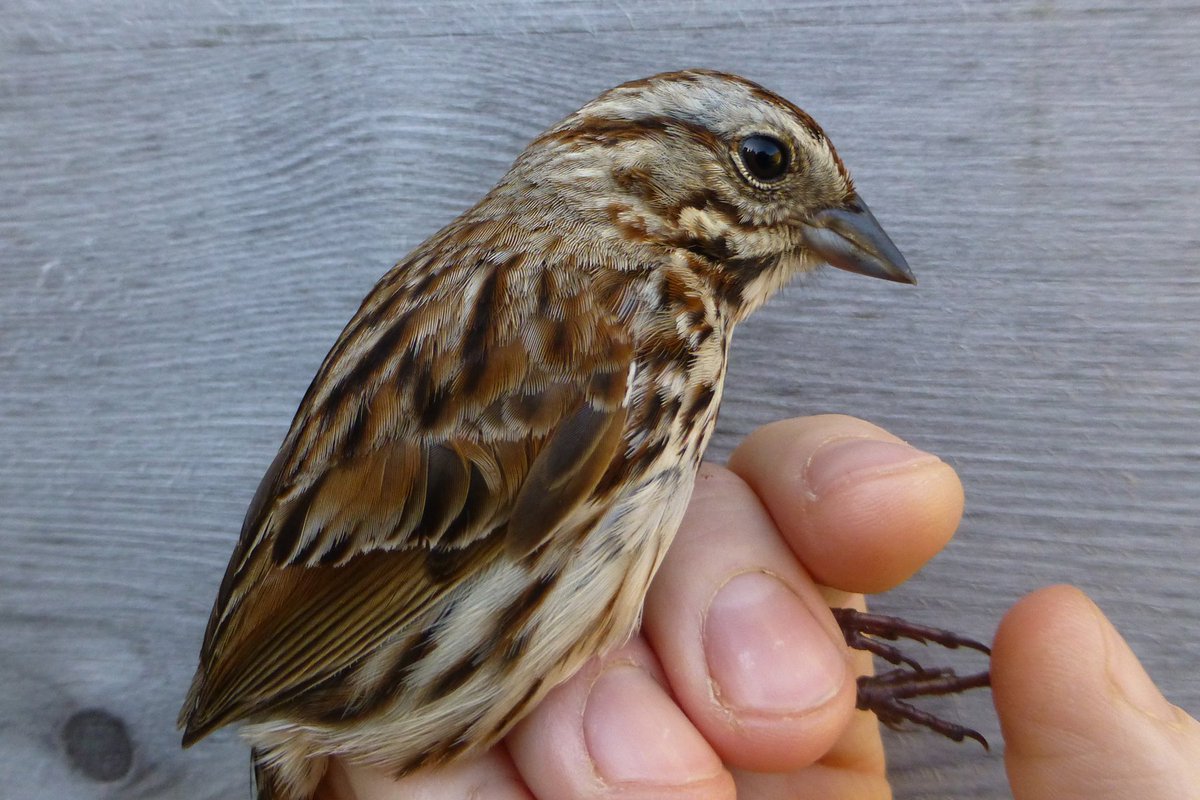
SONG SPARROW. 7:49.. FAIR ISLE. TRAPPED AND RINGED IN PLANTATION.


I need that.
In case you don't know, Fair Isle is essentially a huge inhabited rock which juts up above the sea in between the Orkney Isles and the Shetland Isles. There are ways on and off. A boat three times a week and a daily flight. These go from Shetland Mainland. To get to Shetland Mainland requires a 15 hour boat journey from Aberdeen or a scheduled plane flight from said same city or further south at a cost.
There is one other way. To fly up there from further south in a small plane. In fact, that is pretty much the only way to reach Fair Isle in a hurry. But my extended sleep this morning surely meant that all such options would have been already bagged by others who share my impulsive and compulsive hobby.
With the next two days tied up, I resigned myself to moping around in the garden all day. I would start to make plans for Friday, but not right  now.

I attended to all the animals and it was while I was feeding the turkeys that my phone rang. Did I want to fly to Fair Isle today? You bet!
The precise details of our flight, including the pilot, the plane and the departure airfield, were still not clear, but I needed to start driving North towards the various options. If I left it until the plane was sorted, I wouldn't be able to get to the airfield soon enough.
So I headed cross country to the A1. This road is infuriating when you are in a hurry, as you basically travel at the speed of the slowest lorry or motorhome. There were even two tractors today.
As I approached the first airfield option, I received a phone call that we were flying from further North, up in Yorkshire. The pilot was driving down from Newcastle and should be with the plane by about 1.30pm. There was time for me to jump cars in with my other two birding friends and our arrival time at the airfield should be about the same.
With a flight time of about two and a half hours we should be landing on Fair Isle before 5pm, which would give us a couple of hours to see the bird before we would need to head off again. The last option to top up with fuel was 8pm at Sumburgh on Shetland Mainland. It is not possible to land and take off from Fair Isle landing strip with a full tank, so a refuel on the way home is necessary.

The plan was falling into place, except that the bird, released in to the bird observatory garden at 8.30am, had only shown once briefly at 11am. After plane preparations and putting fuel in, we eventually took off at 2.15pm with no further news of the bird. The weather was glorious so there were no hold ups. We could identify every feature of the landscape as we headed up the East coast and out across the sea towards the islands. I even had enough phone reception to ascertain that the bird had shown again briefly at about 2.30pm.
So that was two sightings in six hours. We would have two hours on the island! Goodbye finger nails.

I have only been to Fair Isle a few times, each time on a small plane, and I am averaging just over one new bird for each trip.
Savannah Sparrow and Siberian Rubythroat 2003. Chestnut-eared Bunting 2004. Swinhoe's Petrel 2013.
As we approached the island I hoped I could make it five lifers in four trips (or more!)

Fair Isle on a clear day

The view down over the island. We did a pass over the bird observatory before dropping down to land on the air strip.
We were concerned that nobody seemed to be looking into the observatory garden as we flew over.
Did this mean the bird had flown?
We had received news of the Song Sparrow's continued presence just before landing. This could be good news, but could also mean that it would not show again for a while.
The lovely thing about landing on small Scottish Islands is that there is always a welcoming committee and they always know about the bird. We were very pleased to hear that the bird was now appearing underneath a feeder with some regularity. We were also very grateful to be able to jump in the back of a car - on the floor, no seats! - and get a lift to the observatory.
Viewing of the bird was from the lounge. How very civilised!

One plane load of birders from Essex had got there before us and there were a few over from Shetland Mainland. There were also those who were up on holiday staying in the bird observatory.
We ran through into the lounge to the news that the bird was showing right now!
I always seem to miss being photographed at twitches, 
but I am actually in this photo. 
I raised my binoculars to peer over those kneeling on the floor in front of me and it only took a few seconds to pick up a movement on the ground deep in the vegetation. A couple of seconds later I had views of a stripy brown back and then the bird turned so that all I could see through the tiny gap was its head in full view. The other two hadn't seen it yet, but it wouldn't be long before it hopped to the outside of the garden into full view. I won't describe it. Pictures do the job better.

This bird had come all the way from North America. It was only the eighth Song Sparrow ever to grace our shores (but the fourth for Fair Isle following birds in 1959, 1969 and 1989.) Most long-time birders saw one in 1994 near Seaforth Docks which had undoubtedly hopped off a ship but is still deemed an acceptable tick. That was the last one.
It was one of those birds which, quite possibly, I would never get the chance to see in this country... until today!
We watched the Song Sparrow for a while, enjoying excellent views as it hopped around in the vegetation under the feeder, occasionally coming forwards through the fence and into the open. It was only about 15 feet away from us. We had not expected views to be anything like this.

Pictures courtesy of @FI_Obs twitter feed

The island also had another special visitor. For just over the hill, zooming around over a rocky beach, was a Crag Martin, a bird which I had only ever seen once in this country. It would be rude to ignore it while we were here. It was only a five minute jaunt over the hill, though you had to stand quite near the edge of the cliff for views down onto the beach. It took a while to pick the bird up, but it was obvious when it showed and easy to pick up from the swallows and house martins which were also catching insects. A gloriously sunny day, sitting on the cliff looking down on the beach and watching puffins looping round over the sea, a Crag Martin below us and a Song Sparrow just over the hill. Fair Isle at its very best.

My travel companions tracking the Crag Martin's every move.
We would have stayed longer but wanted to get back to the Song Sparrow, which continued to afford fantastic views over the next hour. We planned to stay till 7.15, but at 6.30pm we received an urgent message from the airfield that the weather was closing in and the wind was switching.
We bundled into the back of a car, sped to the airfield and jumped in the plane.
The weather can turn fast up here and we didn't even have time to bid farewell to other birders.

The pilot taxied down the airfield, swung it round and headed hell for leather into the wind. We took off into low cloud and were buffeted around a fair bit. The pilot had a heading which would clear us of the rocky crags, but it was still a bit hairy as we bumped around in thick cloud.
It was a relief to come out of the gloom and look back on the island which was shrouded in thick cloud.

After a quick fuel stop at Wick, we settled down for the journey home.
It had been quite a surreal day, not quite what I was expecting when I belatedly woke up this morning. Once again Fair Isle had delivered. What a magical place. Maybe one day I will return and stay for longer than a few hours.


Views from the plane were spectacular as the sun went down somewhere round about Teesside.
Our landing was smooth as could be and we bade farewell to the pilot before heading back down south.
I rolled back onto the farm at just past one in the morning.
It had been quite an eventful last sixteen hours.

Tomorrow, SATs tests. Poor kids.

Monday, 21 May 2018

Hotting Up In The Polytunnel


Early carrots
Sunday 13th May 2018
The Jungle is growing
A bit of sunshine at this time of year and temperatures rapidly soar to over 100 in the polytunnel. Growth is fast.
Crops occupying the beds at the moment are the sneaky ones which will be harvested and gone before the main crops go in.
Mangetout is cropping now

Once all these are gone, their place will be taken with peppers, chillis, tomatoes, basil, sweetcorn, butternut squash, melons and cucumber. These are all grown from seed, sown a while back and patiently waiting for their place in the beds. Once they get their roots down they will grow like billy-o.
They are vulnerable while they are still in modules or small pots, for the soil can dry out within a day and it is easy to lose a whole tray of seedlings. But it's easy to go the other way and drown them too.
With the warmer weather, many seedlings can go outside in the cold frame, where they will not dry out so quickly. But here they become a tempting morsel for the odd slug which finds its way in and spends the days squidged safely in the crevices underneath the modules.


This is why patience is key when sowing and growing. There is no point going too early, for a queue of young plants waiting for their place in the soil makes them vulnerable.

The first coriander of the year and lettuces

Turnips and beetroots coming along nicely

A queue of plants waiting for polytunnel space


Turkey chicks go exploring
Meanwhile outside mama turkey took her chicks for walkabouts today. There are ten of them in all. I was hoping for more like fifteen. They all look strong and healthy though and with the weather set warm and dry I will leave them outside for as long as possible.


Dykes and Drains
With the weather so fine, we took the dogs for a long walk along one of the drains this afternoon. Drains and dykes are such ugly words, but this particular drain is most pleasant at this time of year. The pair of swans have abandoned their nest where the dyke at the bottom of our land flows into this drain, but now we know why, for they have moved further along.
It is good to see that plenty of hares have survived the winter hare coursers this year, though they lead Arthur and Boris a merry dance. Arthur is under the illusion that his stumpy little legs are capable of helping him catch up with a hare half way across a field. To be fair, he has a good go!

Sunday, 20 May 2018

Turkeys In A Twizzle

Saturday 12th May 2018
The Turkeys Hatch


A few weeks back our hen turkey started sitting on her eggs. So it was no surprise when she started to hiss and be much more protective when I ventured into the turkey enclosure yesterday. And it was no surprise when I saw discarded egg shells and three little heads poking out this morning.
The surprise will be how many there are and what colour. The male is mostly Lavender and the females are mostly Bronze, but since they are being bred for meat and not show we are not purists when it comes to fancy feathers. The important thing is that they are not double-breasted monsters and that they will be slow grown, as nature intended.
For now I shall leave well alone. They probably won't venture off the nest till tomorrow and there may well be more eggs hatching under the hen.
The Silver Stag behaved himself too. He gets close enough to feel a little threatening but trusts me enough to just stand close guard.


Earthing Up The Spuds
I left the turkeys alone and turned my attention to the potatoes. They are all starting to poke their leaves through the surface, so there is the small matter of earthing up to be attended to. I have learned a few short cuts when planting my spuds. No longer do I dig back-breaking trenches for them, but instead I just plant each tuber as deep as I can with a trowel. For the past few years I have then pulled the earth up over them with a draw hoe to create ridges. This is important to protect the leaves from late frosts and to prevent the new tubers from turning green through exposure to light. They often grow surprisingly near the surface.
This earthing up process often requires repeating as the potatoes grow more, or as the chickens do their best to make the earth flat again. They are banished from the veg garden for a few months now, but several of them still venture over gates and fences for a bit of a scratch around. They will learn the summer rules once they have been chased out a few times.
This year I am trying a different process, only earthing up as the new leaves appear. On the new potatoes I am using compost and old bedding straw to earth up, hoping that this will slowly release its goodness into the soil below. The chickens are finding this even more delightful to scratch around in, but it is lighter material and easy to pull back into position. Once it settles down they will leave alone.


Friday, 18 May 2018

The queen is dead

Sunday 6th May 2018
The queen is dead
Lovely Weather!
But I couldn't spend too long outside today as Sue was planning on killing one of her queen bees. I know this sounds a bit drastic, but queens don't keep laying well for ever - a bit like chickens really.
Like many others this extended winter, Sue's bees are struggling a bit. The smallest colony is barely hanging on and the queen in the largest colony has started laying drone brood - that's male bees. In the world of smallholding, males are pretty useless. One of each species is generally enough.


Today I needed to keep my distance from the bees would likely not be happy, though using lavender cuttings in the smoker seems to be having a calming effect on them.

So I decided to erect my bean poles. I use old willow for this which the sheep enjoy debarking for me - this stops the poles taking root.
I dig these in about a foot and stamp the soil back down around them to secure. They are sturdier than bamboo canes and carry a lot less 'food' miles. They are better looking too and give some real height and structure to the vegetable garden.

For the first time in ever I have actually got the bean poles erected in advance of the beans being ready to be planted out. In fact I have not even sown them yet.
I prefer to sow them in paper modules indoors rather than direct. I can get  slightly earlier start but more importantly they are protected from birds and voles. Further, germination can be a bit patchy if the soil is not warm enough, so if I grow them in modules I can make sure that every pole has a bean.

The bottle fed lambs, Flash and Rambutan, are getting big now. They have become good friends and nothing pleases them more than a little run around with the dogs. Rambutan is Boris size and Flash is Arthur size.


Monday 7th May 2018
Getting Crabby

I've just got to show you this crab apple. Look how much blossom! I am anticipating a good year for all our fruit trees this year. Even if I say so myself, I have done a good job of pruning them. We had a decent spell of cold weather in the winter to kill off some of the nasties and we seem to escaped any heavy frosts, high winds or hail storms at the wrong time of year.

Tuesday 8th May 2018
Been bean sowing

A day of seed sowing and potting up. timing the sowing of the beans is a fine art. For they grow quickly but can't go outside until we are frost free. Most of them are for drying so I need as long a season as possible. For these I prefer to grow climbing varieties as they are up in the air and more exposed. It is hard to dry the beans on dwarf varieties which are low to the ground and shaded by their own leaves.

For seeds and seedlings sown earlier in the year I use plastic trays and modules, but for those sown late which go in the ground quickly I make paper pots, wither round ones using a special wooden shaper or cube ones using origami.
I like the fact that they are reusing old paper and that they can be planted straight in the ground with no further rot disturbance.


Monday, 14 May 2018

If Only All Rainy Days Were Like this

Tuesday 1st May
The Worst Weather Forecast Ever
I was super surprised to be able to mow the lawns yesterday. For the forecast was for heavy rain and strong winds all day. We must have been right on the edge of it, for we had a dry day with not a spot of rain. There was a gusty breeze in the morning, but even that had calmed to a steady blow by early afternoon.
Having missed out on the opportunity during the recent warm weather, I grabbed the chance to start up the lawn mower for the year.

I went over the lawns again today, collecting the clippings and using them to mulch the blackcurrant bushes and raspberries. Then my attention shifted to the other lawnmowers, the sheep.
The three rams needed to move back up into the main sheep paddocks and I hoped they would settle in quickly without hassling the ewes or their lambs too much.
As it was, the operation went very smoothly and the flock is reunited successfully.


Sunday, 13 May 2018

The War On Slugs

Saturday 28th April 2018

The War Against Slugs
I made some new slug traps today from old plastic food pots. I am having a concerted attack on the blighters this year, using these techniques:
Night time hunts
Placing planks on the ground so the slugs shelter there during the day
Ducks - now living in the veg plot
Slug traps - filled with beer slops or, failing that, a sugar and yeast mix
Slug pellets - ferrous phosphate, organic and wildlife friendly (except slugs)
It is a battle which requires prolonged and sustained effort.


A New Home for the Table Birds

Next I moved the chicks from the broody ring in the garage. They have very quickly outgrown their space. They were very excited to discover the great outside, but even more excited by their new feeders!


Doing my bit to build a community
In the evening we had a local group of smallholders coming over. This is a group I started up as part of the Fenland Smallholders Club. We had a lovely evening and I am sure the group will go from strength to strength over the years. Everybody lives within a short distance of each other which means we should be able to coordinate some of our smallholding activities. Hopefully friendships will form and we will all be able to help each other out when we need it.

Saturday, 12 May 2018

The Little Things I Notice

Friday 27th April 2018
The week didn't hold much excitement apart from this amazing rainbow which appeared over the fields while I was driving back from work. I could only quickly snap it as I pulled up in the oncoming lane and the picture doesn't really do it justice.


I try to notice something new on the smallholding every day. It may be a new sapling I'd not noticed before, a plant coming into flower, a hedgehog dropping, anything really. I don't know what it will be till I see it.

This week's notable things have included:

Newts in the pond

There are pond skaters, diving beetles, whirligigs and water boatmen too. I've not even put any plants in yet or finished the edging.

A pair of mallards appeared early one morning too. Apologies for picture quality, but it was taken through the window to avoid flushing the birds.


Mushrooms growing in the orchard


Snails

Ashy Mining Bees - a lovely little grey and white bee which I observed nuzzling into the soil deep down in the grass. Not rare, but the first time I've seen one and identified it.


Friday, 11 May 2018

A new meadow

Sunday 22nd April 2018
So the heatwave is officially over!
I missed my opportunity to catch up with everything due to other commitments.
With heavy rain forecast for later on today, I did manage to get out early and do some more planting before the soil becomes unworkable again.
The first of the outdoor carrots are sown. Hopefully the soil will be warm enough that they get a good start. And I've put a row of spring onions in too, though it won't be spring by the time they are ready.
I am more organised with my brassica seedlings now too. I raise them in modules but always used to leave it too long before moving them on into the open soil. But I now plan into my rotation to have a nursery bed where they can grow on before going to their final positions. The bed will never be full and will be empty once all the seedlings have gone through, so I will use it as a spare growing area if I need it, otherwise I will plant it up with green manure plants.

Many of the seedlings in the polytunnel are big enough to survive outside now. In fact, the hardier ones would prefer it outside and are safer out there where there is less risk of the modules drying out. The only risk is that they become waterlogged if there is lots of rain, so I have to remember to periodically empty the trays they sit in. There are still a few weeks until we are safe from overnight frosts, but there is none in the immediate forecast so these plants will have plenty of time to harden off in my old open-toped greenhouse which acts perfectly as a giant cold frame.

Monday 23rd April 2018
With the forecast rain holding off for now, I went back over the meadow area with the rotavator.
I plan to have a permanent bee and butterfly meadow area in an area where I used to sow annual seed every year. This worked until the borage and nettles started coming through too strongly year on year.
The first rotavation was about a month ago and turned most of the weeds under, but I wanted to create what is called a stale seed bed. After turning the soil, a carpet of seedlings appears. So you wait for this to happen and them lightly work the surface to kill them off. Now your area is ready for sowing.


I purchased a 20% wildflower mix from Boston Seeds. The rest is a mixture of meadow grasses. Most of the wildflowers won't show in the first year, so I spent a little extra for  a mix with cornfield annuals added to give colour in the first year.
This is part of my new wildlife area, which includes the bug hotel, the wildlife pond which I have now reclaimed from the ducks, a couple of willow coppice areas and a managed nettle bed.


Looking Back - Featured post

ONE THOUSAND BLOG POSTS IN PICTURES

Ten years and a thousand blog posts! Enjoy. Pictures in no particular order.  

Related Posts Plugin for WordPress, Blogger...