Saturday, 27 December 2014

All the muddy slush without the fun.

I was up bright and early this morning to capture the amazing winterscape at sunrise. For when I went to bed, this was the scene outside.


At the tender age of 48 I still find this inexplicably exciting and could sit and watch the snowflakes tumbling all day long. The only problem last night was that it was absolutely pitch black. With no artificial lights outside, the only way to actually see the snow was to fire the camera's flash and capture it mid fall. By the time I went to bed the ground was white.

So I woke up somewhat reluctantly at just past 7 this morning. My body was telling me to snuggle back down into my cosy bed, but we had no snow last winter and I was keen to capture the farm and the fenland landscape at it's wintery best.
So imagine my disappointment when I looked out of the window to see rapidly developing puddles of slush. Overnight the snow had turned wet and nature had taken all the fun away. All we were left with now was cold wetness, muddy slushiness. I climbed back into bed and pulled the duvet over my head.


I did eventually get up, for there are always animals to look after and in this weather that job becomes even more important. We've deliberately gone for hardy breeds as it can get rather bleak here in the winter. The Shetland sheep, while not looking overly happy about the situation, did at least seem to be taking it in their stride.


The guinea fowl, who never cease to amaze with their toughness, were looking a bit bedraggled but no worse than that. Presumably last night was one of the rare occasions when they abandoned their exposed perch and headed for a modicum of shelter.


Happiest of all seemed to be a rather large flock of fieldfares who had gathered a little further down the land and seemed to be enjoying the decidedly damp ground, for the snow melt had created some rather large temporary pools.

Which reminds me, I really must go and sort out the bird feeders. I've been holding back on this as the rats have been more numerous than usual this year (hopefully a cold winter this year will sort them out) and I don't want to do anything to encourage them. It's decidedly hard at times here to prevent the food scattering all over the floor as the wind buffets the feeders.

Thursday, 25 December 2014

IT'S CHRIIIIIIISTMAS!!!!!!!


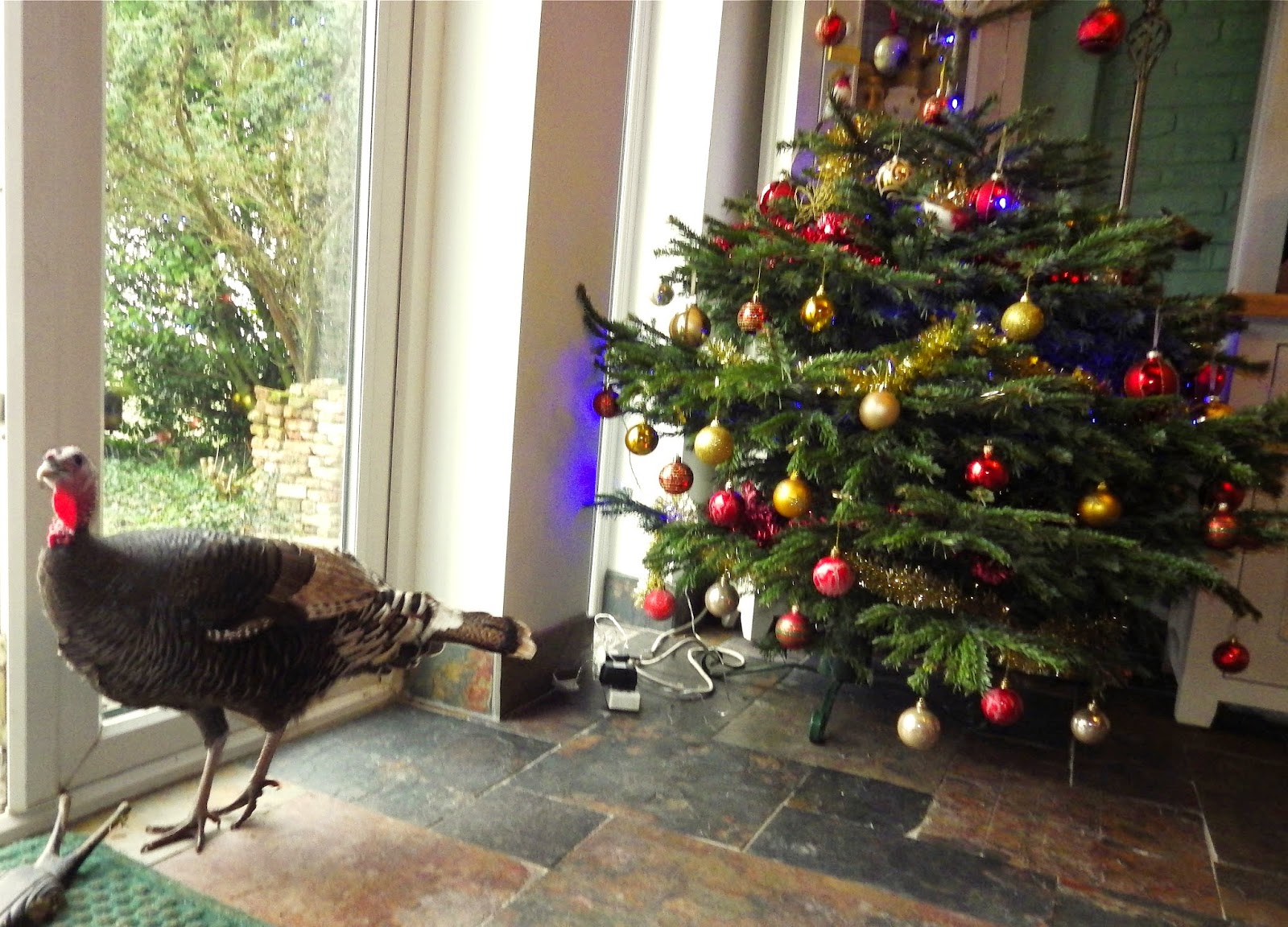
Well, it's 25th December and I guess an update on the turkeys is in order.

Firstly, the two girls were very relieved to join the small group of their kind to have witnessed our human yuletide celebrations. After their day sulking and pining for their departed stag, the very next morning the turkey hens headed outside as if nothing had happened. They proceeded to hang around me all day in the garden, helping by uprooting the shallots I had planted the day before and stealing the garlic cloves which I was planting.


Since they are so friendly and due to their unexpected longevity, I have decided to give them names. They are to be called Ethel and Gertrude. For some reason, these names seem to fit them very well. It is unlikely that I will ever be able to work out which one is Ethel and which is Gertrude. I will have until about the beginning of March to achieve this, when there should be enough room to accommodate the pair of them in the freezer!

The boy on the other hand got all hot under the collar today, so to speak. As usual Sue and I have had a quiet Christmas day just enjoying each other's company. Boy turkey provided us with a veritable feast for two. Very tasty he was too!
He wasn't huge. We never tried to get our turkeys to an exaggerated weight. There was no point pouring expensive pellets into them to end up with a goliath which we became sick to death with by the time we were reduced to turkey curry on New Years Day. Instead we grew them slowly and allowed them to roam the smallholding pecking at this and that all day. They shared their food with the chickens, ducks and guinea fowl.

Anyway, I can't spend the rest of my Christmas Day tapping away at the computer. I've got a giant drumstick to tackle, followed by a mountain of mince pies and sausage rolls.

I hope you've all had a good one.

Monday, 22 December 2014

Do they know it's Christmas time? I'm talking turkey!


Yesterday marked the winter solstice. I'm no more one for celebrating pagan festivals than I am for celebrating Christmas. But have no fear, this is not another bah humbug post.

However, the ebb and flow of the seasons has a huge impact on our lives now that we live off the land. The shortest day marks the time for planting out shallots. They'll be ready for gathering on the longest day. I was kept busy taking cuttings yesterday, so the shallots went in a day late. The soil at the moment is delightful to work.

Anyway, back to our Christmas celebration and this year, for the first time ever, we have been raising our own turkeys, a stag and two hens. For one of them, the shortest day really was the shortest day! What's more, they seemed to sense impending doom. All morning they were behaving oddly, first refusing to come out of their stable, then wandering to parts of the farm to which they had never previously ventured.
The two turkey hens even jumped the gate and mixed it with the sheep in the top paddock. I don't think the stag (that's the boy) is physically capable of jumping a gate any more as he has been making a decent effort to fatten up for Christmas!
But the sheep got curious which resulted in a hasty retreat by the hens... into the sheep shed. I looked away for a moment and, when I looked back, three of the sheep were in the shed. They don't usually spend much time in their unless the weather is foul, but they stayed in there for over five minutes, just staring into the corner. In the end I decided to end the stand off. The poor turkeys were just standing in the corner, hemmed in and completely puzzled about how to extricate themselves from the situation.

So, about 3 o'clock in the afternoon I led the turkey trio back into their stable, as I do every day. But from there I headed to the kitchen to put a large pan of water on to boil. I then got ready an old table top and a broom handle. I'll leave the rest up to your imaginations! (Don't worry, the broom handle's not for bashing them.)


A suitable sunset for the turkey stag to go out on.
While we had everything set up, we decided to thin down the Cayuga ducks as somehow we had ended up with three drakes. Choosing which would go was straightforward, as the biggest of the drakes was also the one with a little too much white to count as a proper Cayuga... He'll be rueing those white feathers now.

An old photo of the Cayugas.
They never stay still long enough for me to get many photos.
This was the first of our ducks we had ever killed for eating.

While we were on a roll, we decided to dispatch our first ever guinea fowl too. Evening is the time for this, as they can simply be plucked (excuse the pun) from their roosting perch. Catching them during the day would be a different proposition altogether.

The best time to catch a guinea fowl.
To cut a long story short we ate the guinea fowl last night. We'd eaten them before, in East Africa, so were keen to see how our own birds would compare. Considering that this bird was well over a year old, it tasted very nice indeed. In fact we'll definitely start 'harvesting' our guinea fowl on a more regular basis from now. The duck we prepared last night and roasted today. Again we were not disappointed. All those slugs from the vegetable patch have obviously given the ducks a very special taste!

As for the two surviving turkey hens, they have spent the whole of today inside their stable, despite the door being open for them to wander at will. Sadly, I think they have been calling for their 'man'.

Earlier in the year on our poultry dispatch and preparation day.
It may not be everybody's cup of tea,
but our birds have great lives and are dispatched quickly.


The turkeys have really surprised us with how gentle and friendly they are. They are a social animal too, never straying far from each other. I really hope that the two birds we have left can get over their loss quickly. When their time comes, which will be later in the winter, they will both go at once since it would clearly be unfair to leave one on its own.

Meanwhile, the days are getting longer now. The chickens have started laying again and tomorrow I've got bean trenches to dig and compost to spread in preparation for the next growing season.


Sunday, 14 December 2014

Welsh Eggs and Olde English Cyder Cake

If you got a dazzling display of Christmas lights outside your house, then it might be an idea if you didn't read any further!!

For everybody else...

Last night was the Fenland Smallholders Christmas bash. Sue was not only providing her school hall, but was also providing half of the night's entertainment singing in the smallholder's music group, The Sugar Beats.
I meanwhile was doing my usual grumpy Christmas thing. I really don't like Christmas. It's not just an act. I actually don't like it.
My pet hate at the moment is ridiculous, garish displays of flashing lights festooning people's gardens, walls, roofs, garages, sheds, trees... What's it all for?

Anyway, that's enough of my grumpiness (for now). I was faced with the difficult decision of what food to take along to contribute to the Christmas feast. As much as I could happily live on mince pies, sausage rolls and trifle, I really didn't feel like preparing anything so festive. Besides, there would be plenty of that food available.
I scoured recipe books without inspiration. My general level of Christmas grumpiness was rising off the scale. I searched the interweb. Still nothing gave me that spark. Back to the books and some of the older ones which I rarely go to these days. And voila!

Old English Cyder Cake. It fitted the bill perfectly. Traditional yet different. Simple yet interesting. Using up cupboard staples and a few ingredients such as eggs and cider which we always have available.
Then, like buses, along came another recipe which fired my imagination.
Welsh Eggs. A vegetarian version of Scotch eggs which used herbs and leeks in it's stuffing mix. Again, ingredients which I could just go pick straight from the garden.

A rare Saturday morning trip to Morrisons ensued, for there were a few ingredients I needed to get. I expected the worse. After all, a supermarket on Saturday in December was sure to be my personal Room 101. I could already hear the Christmas music wafting joyfully through the aisles. I could envisage the masses of shoppers stocking up as if a nuclear war were imminent. Yes! My Christmas spirit was really coming to the fore.
I raced my trolley around the aisles in an effort to minimise the whole experience. To my pleasant surprise, it was actually fairly quiet and when I got to the tills I had a choice of three empty ones.

So I returned to the farm relatively unscathed by my venture out into the world of Christmas consumerism and set about preparing my two dishes.

I tackled the sponge first. It involved a technique I'd never used before, beating the eggs in a bowl over hot water. I was later informed by Sue that I'd made my first 'whisked sponge'. Everything went well and after just over an hour in total the finished product emerged from the oven.


It was light and it smelled and tasted of cider! I know it's called Cider Cake, but I really wasn't expecting the cidery taste to come through quite so strongly. But it was actually very pleasant to eat indeed. Well, I had to try a slice first before inflicting it on the general public. I also had the cumbersome task of finishing the bottle of cider, which I did while embarking on the second recipe.

While the eggs boiled I popped into the veg garden and pulled a couple of smallish leeks from the ground. I trimmed the roots and outer leaves straight into the compost bin, then proceeded back past the herb bed where I gathered a large bunch of parsley and a little thyme, which is not at its best in the winter.
In no time I had mixed up the stuffing (can you call it that when it goes on the outside?). I entombed the eggs inside and rolled each ball in beaten egg before coating it in dried breadcrumbs.
Into the fryer for 3 minutes and ready!
I used to be a vegetarian and when I tasted these Welsh eggs it reminded me why I enjoyed cooking so much during this phase of my life. The leeks, herbs and a generous dash of lemon combined brilliantly to give a surprising, fresh and zingy twist to the traditional Scotch egg


And so at 7 o'clock I snuck my creations onto the table amongst the mince pies, cakes, sausage rolls, trifles, sandwiches and more. And do you know what? I didn't even get a slice of Welsh egg. They were snapped up in no time and everybody was pleasantly surprised. I had to compensate by eating a mountain of mince pies instead!

I sat back and listened to Christmas carols. They sound a lot better when Sue is singing them than they do in the supermarket. Not that I was too tempted to join in. Highlight of the evening (though the company and entertainment were, of course, excellent), was our table trouncing everybody else in the quiz...oh, and winning a couple of ducks in the raffle.

Just in case you're still reading, here are the recipes:

Old English Cider Cake (It's an old recipe, so measurements in imperial!)
4oz butter or marg
4oz caster sugar
2 eggs (I know it's a struggle at the moment, so thank you hens)
8oz plain flour
1 tsp baking powder
1/2 nutmeg, grated
1/4 pt cider (this always tastes better if you picked the apples and pressed them yourself)
Icing sugar for dusting

Cream the butter and sugar together.
Beat the eggs in a bowl standing in a pan of hot water, until thick.
Stir the eggs into the mixture.

Sieve the flour, baking powder and nutmeg together.
Sir half the flour into the mixture.

Beat the cider until frothy, then stir into the cake mixture.
Add the remaining flour.

Mix everything together well.

Spoon the mixture into a lined and greased shallow cake tin.
Bake for 45 minutes at 180C (I can't do a degrees sign while typing in blogger!!) until golden brown  -mine took 50 minutes. But check before the 45 minutes is up.

Allow to cool and dust with icing sugar.

Slice and eat.


Welsh Eggs
5 eggs, hard boiled (thanks again, chickens!)
flour, seasoned with salt and paprika (enough to coat the eggs0
1 leek, chopped finely
2 tsp oil
120g fresh white breadcrumbs
grated rind and juice of 1 lemon (preferably unwaxed)
50g vegetarian shredded suet
4+ tbsp. chopped fresh parsley
1 tsp fresh thyme (or use dried, herbs of your choice)
salt'n'pepper to season
1 egg, beaten
75g dried breadcrumbs (I used golden)

Peel the hard-boiled eggs and toss in seasoned flour

Fry the leeks in the oil for 3 minutes.
Cool, then mix with the fresh breadcrumbs, suet, herbs, seasoning, lemon rind and juice
(If mixture is too dry, add a little water)

Shape the mixture around the eggs, then coat with beaten egg followed by dried breadcrumbs.
Cool for half an hour in the fridge

Deep fry at 190C (hot! :0) for about 3 minutes (do this one or two at a time).

Leave to cool and enjoy!

Wednesday, 10 December 2014

Yacon

Eight months ago I received a small package in a padded brown envelope. Inside I found four small chunks of tuber and a set of instructions.


The package had come from The Real Seed Company, a great little organisation who sell seeds and tubers and positively encourage growers to propagate their own from this starting point. They are one of the few sources of a tuber called Yacon. It's not cheap, but they promise to supply three tubers with an absolute guarantee that at least one will grow.
As it was, I received four tubers and all of them grew! As with other similar perennial crops, such as Jerusalem Artichoke, Chinese Artichokes and Comfrey, I have found that a modest initial investment gives me a crop for life which I can increase by division as much as I choose.

A little bit more about Yacon, also known as Aricoma or Poire de Terre (Pear of the ground). It is another of those Andean tubers. Looking like an overgrown dahlia tuber, it gives rise to an attractive plant which grows to about 4 foot tall with large, architectural leaves. Late on in the year it is topped by small yellow flowers which belie its relationship to sunflowers and Jerusalem Artichoke. And like the latter, the sugars contained in the tubers of Yacon have special qualities (though so far at least not the flatulence inducing qualities of 'Fartichokes'!)
The tubers contain fructooligosaccharide, (fruck-toe-olli-go-sack-a-rides... I think) which taste sweet but which contain virtually no calories. As you can guess, there is a lot of interest in such a crop from the diet industry as well as potential uses for diabetics. Furthermore, fructooligosaccharides (that word again) have a prebiotic effect, meaning they are used by beneficial bacteria that enhance colon health and aid digestion.
The yacon plants just after they had been hit by the first frosts

But of course, what you're really wondering is "are these just another trendy crop which doesn't actually grow very well in this country or taste very nice?"

10 kg of yacon tubers
Well I'm pleased to report a crop of 10kg from my four plants. The tubers appear to have more uses than I anticipated. Firstly, they really are very refreshing eaten raw. A very subtle taste, but sweet, juicy and fresh. I have seen the taste described as anything from pear to apple to violet. I guess it's subjective, so I won't even try to compare it.
The most attractive feature for me, though, is its texture. It is wonderfully crisp and stays firm and crunchy even when cooked, a little like water chestnuts. Many sources recommend cutting it julienne style and incorporating it into stir fries. I have tried this and it worked very well, but I have also tried it diced into vegetable dishes and it has added crunchiness and taken on the flavours and spices of the rest of the dish. Overall an exciting new addition to the kitchen larder.
The only downside I have found so far is that it browns on cutting so needs to go into lemony water, but it is browns nowhere nearly as badly as, for example, an apple.

As for storage, I am treating my yacon tubers like potatoes. They are sacked up in a dark cupboard in the garage. I am hoping they keep well this way.
The tubers I refer to are the large tubers found growing under the crown of the plant. But above that are a different type of tuber, the growth tubers. These are next year's plants.

The advice on the delivery packet was to cut these into 1 inch segments and store in cool, dark conditions protected from frost. When it came to it, there was a very grey area where growth and storage tubers all seemed to merge into one large mass. So I have stored what I can - if I've got it right, I could end up with about 100 viable plants next year! Then I read somewhere else to store the whole crown until next spring. Fortunately the part of the crown nearest the growth points was very tough to cut, so I actually ended up with a couple of crowns anyway. All of these are now stored in compost and sand filled containers hanging from the beams in the garage to protect them both from frost and from rodents.


Unfortunately none of my livestock seem to relish the taste of yacon as much as I do. The geese, the chickens and the sheep have all turned their noses up! I may try some on a friend's pigs though, as I know that Jerusalem artichokes are supposed to be an ideal food for their digestive system. If they like it, I may well be finding a space to grow all hundred plants next year if the tubers make it through.


Monday, 1 December 2014

Romanesco and Cavolo Nero

Romanesco and Cavolo Nero
will go nicely with Pheasant tonight
You've got to hand it to the Italians. They certainly know how to grow a good brassica!

I have often waned lyrical (I guess this is the opposite of waxing lyrical) about brassicas.
Cabbages, Greens, Sprouts, Broccoli... they are all green, they all taste and smell roughly the same (caterpillar poo springs to mind), they take up inordinate space in the veg garden and they are nigh on impossible to grow as, for some very strange reason, everything in the natural world seems determined to eat them!

However, I do like a challenge.

I remember as a teenager deciding that I really should eat green things. I would eat just one sprout every time they were served up and eventually I actually came to quite like them. I won't go any further than that though. The same goes for broccoli. Cauliflower I actually do like - maybe that's because it's not green. I did manage to grow a cauliflower earlier in the year, my first ever. I got it past the cabbage flies, past the caterpillars, past the pigeons and then, right at the last moment, some giant slug found it! So disappointed.

Continuing with the 'not green' theme, I have found that I like Red Cabbage too and we managed to grow a few right through to the eating stage last year. I even won the 'above ground' category in the Smallholder Show with my Red Cabbage.

So, what about the Italians I mentioned?
Kale forest
Well, another brassica which I've come close to success with in the past is Kale. It takes many forms. There's borecole, aka Curly Kale, which comes in Red and Green.

Curly Green Kale
Then there's Cavolo Nero, aka Black Cabbage or Black Tuscan Kale.Cavolo Nero is one of the brassicas I want to highlight today. On our fertile Lincolnshire soil the kales seem to grow very well. They seem more resilient than other brassicas. I've had a little trouble with caterpillars, but only really during the Cabbage White plague year of 2013. In general, a modicum of netting is all that is needed to get Cavolo Nero past the pests. It is a handsome crop and produces plentiful leaves in a relatively small area. Furthermore, it actually tastes rather pleasant.


For more on Kale, it even has it's own website with some very good background information and recipes. Just click discoverkale.

The second Italian brassica of the day is Romanesco. Another very good looking vegetable, Romanesco has me a little confused as I still cannot work out whether it's a broccoli or a cauliflower. Anyway, I decided to try growing some this year. The seeds went into modules in the polytunnel early in the year. As usual with brassicas, they germinated well. I remembered to thin them out to one seedling per module. Then something amazing happened. Brassica seedlings always seem very slow to grow and invariably I forget about them in the May mayhem of a busy veg grower. They either dry out or I discover them sometime in late July, all leggy and well past the time when they should have been planted out. All this would be avoided if I grew them the old fashioned way, in a seedbed, but that means outside which means standing guard over them day and night to protect them from invading hoards! Anyway, the amazing thing that happened this year was that my brassicas all got planted out into the garden at the right time... Then I forgot about them!

What with the netting, the weeds and the giant proportions to which some of the brassicas have grown, I just never got round to inspecting them very often. So it was with some great delight that yesterday I discovered a Romanesco ready to eat!


There were another two which had flowered and gone over, but never mind that. The first time you harvest any vegetable is always special, and this little beaut was no exception.

I may also get some Brussels sprouts this year and the Purple Sprouting Broccoli (as opposed to supermarket 'broccoli' which is really calabrese) is looking promising for later in the winter.

So all in all my brassica growing is most definitely improving year on year and I've even found some which I quite like eating. Especially the Italian duo.

Saturday, 29 November 2014

Winter's on its way.


The last few autumn leaves are still clinging onto the trees, but a couple of morning frosts in the last week are a reminder that winter is not far away.


While the thistles have already died back to spiky rosettes, my mahonias, which look so exotic, are looking their best as they come into flower. Mahonia is a very important bee plant, for our honey bees will still occasionally come out on warm winter days and there will be very little for them to forage on. Without plants like mahonia, they will just be using up energy worthlessly.


Gerry, too, has been getting into the spirit of Christmas, bringing home plenty of presents. I'm not sure who these presents are for though. I suspect they are peace offerings for Angel, who has never liked him since she moved in, despite his most patient efforts. Maybe it's because we had Mr Charlie Brown, a friends puppy, in the house a couple of weekends back, but something has persuaded Angel to be slightly more tolerant of Gerry of late.
 
Anyway, I went into the kitchen this morning to find a poor vole curled up next to a large tuft of grass.
 
Gerry often pounces into the grass and brings everything away in his mouth, vole, grass and all. This sort of gory find is not unusual, but I was somewhat surprised to then come face to face with these presents placed just inside the patio doors.
 

It seems Gerry had a very busy morning and it wasn't his last catch of the day either.
On the plus side, he has been catching voles since he moved onto the farm and there certainly still seem to be plenty around!
There are still plenty of kestrels, barn owls and little owls around.


Monday, 24 November 2014

Meet OCTOPARSNIP

At the last count, 110 people like me.

Well, to be a little clearer, they 'liked' my Facebook post when I announced that I'd managed to cross an octopus and a parsnip to create Octoparsnip.

Of course there were various suggestions for marine life/vegetable crosses... I'm sure you can make some up of your own.

There were also plenty of people who had managed to grow similarly monstrous parsnips. Some attributed this to stones in the soil, but stones in my veg plot are rarer than hens' teeth.
They also say that too much goodness in the soil causes root crops such as carrots and parsnips to split, though I've also read that this old belief has been scientifically discredited. Who knows?

My suspicion is that maybe I just didn't dig deep enough. I can't remember whether I just churned the surface with the rotavator or dug deep with a fork. Not that it really matters, but a conventional parsnip is certainly easier to peel.

Mind you, I can grow them conventional too.


Saturday, 22 November 2014

Naans, Parathas, Santa logs and Pumpkin Soup

Flatbreads ready!
Courtesy of Blokes Baking group.
I belong to the Fenland Smallholders Club which provides me with an excellent excuse to spend time with fellow smallholding friends.

As a part of this, a while ago I set up a Blokes Baking Group and last night we were attempting to make naan breads and parathas from scratch. I had the idea of buying in a takeaway curry (minus the flatbreads) to accompany our efforts.
At the last minute we decided to break with tradition and invite the Widows of Blokes Baking along too.

In fact, everything was a bit last minute. I didn't even look up recipes for Indian flatbreads until the evening before, by which time it was too late to buy authentic ingredients such as chapatti flour and ghee. Ask for these in Holbeach Tesco and you'll invariably be met with a very puzzled look! Not to worry, I could make the ghee and the flour could be substituted. On the plus side, they did have Indian lager on special, so multiculturalism is alive and well in these here parts.
The only other ingredient I was short of was garam masala, a mix of spices commonly used in Indian cookery.
I was lucky enough to find some of this on the shelves, but baulked at the price - £1.75 for a little jar. You've got to be kidding! So instead I took a photo of the ingredients and ground my own when I got home, all from whole spices. The result was a fragrant and spicy powder which did an excellent impression of garam masala. So that's another product I won't be buying in the future.

So, back to the Blokes Baking. One of the naan recipes used yeast and a double rise. If we started this process at the usual time, we would need to eat at about 10pm. So I did all the prep work before the others arrived.

Bring on the feast!
I found the recipes on Youtube - search for Titli's Busy Kitchen for some excellent recipes. They are even accompanied by some very clear videos and Titli is definitely a character. Alternatively, you can just click here.

The Blokes now work well as a team, so we divvied up the bread-making duties. Dave took responsibility for the Aloo Parathas and was most impressed when they puffed up on the hotplate. Phil took the plain Parathas, which involved a little origami to create layers in the bread. I took on the Naan breads. A keema naan stuffed with minced Shetland lamb from our very own fields and another naan recipe topped variously with nigella seeds, chilli and coriander.
We had the oven, the grill, the griddle and a couple of heavy frying pans on the go. In all we produced nineteen breads! And just as the last naan was going into the oven the takeaway delivery arrived. Perfect timing.

What followed was a feast of monumental proportions enjoyed in very good company.

Then it was up bright and early (well, Sue anyway) to make a giant pot of pumpkin soup for the monthly Smallholders Meeting. This wasn't quite in our plan, but we were asked at ridiculously short notice. No harm done anyway.
The Smallholders meeting was to be a series of demonstrations of Christmas crafts by fellow smallholders. Decorative glass painting and Christmas wreaths were not really my thing, but were still much appreciated. But what did impress me were these:


Simple to make from logs cut at an angle, some of these will certainly be guarding our door this Christmas. They may be my one concession to Noel festivities this year!

And on the plus side, when Santa comes down the chimney this year, he can stay on the fire!!


Sue and some of the other smallholders start their Christmassy creations.

Thursday, 20 November 2014

Lean pickings

"But I don't want to go"

I am still learning about smallholding every day, but over the last couple of weeks I've learned a big lesson about keeping sheep. For the time has been and gone for some of them to go on their final journey. Along with the sheep I bought from the Rare Breeds Centre went the small Shetland ram who for some reason had avoided the snip when he was little.

The plan was that eight of these would go to the butchers and be sold on as meat. The Shetland lamb and Number Six (who was always the runt of the pack) I was to just get 'processed' at the abattoir and then they were to have a special role being used at the Fenland Smallholders Butchery Group for Phil to teach us how to butcher our own lamb. It's not as violent or as gory as it sounds. Back to that later.

I had been a little worried about the size of the sheep this year. I didn't get them till it was very late and they seemed to take an age to really begin growing. On top of that, the grass has been nowhere near so lush as in previous years. I also somewhat rashly ended up with a few too many sheep. Don't worry, it's not as if they are skeletal or even skinny, it's just that they didn't seem to have grown to such bulky proportions as last year's lambs.

So I was expecting that they might come in a little under the 16-18kg I was hoping for. Maybe 13 - 15 at the lowest. As for the smallest two, I thought they might make about 10 and 12kg.
Well, how wrong I was! When I picked up the first batch from the butchers, only two of them came in above 10kg. The smallest was less than 7kg!

This was disappointing to say the least.
Firstly, I would have to let them go at half the price I was hoping for and hope that people still wanted what I could offer them. On the plus side, at least it would be nice lean meat.
Secondly, it was embarrassing that I had not managed to properly fatten up my lambs.
Thirdly, I still had a flock of Shetlands and it had become clear that I would not be wanting to carry so many sheep through the winter or through next year.


The Shetlands enjoying a frosty morning last week.
Fortunately I was still able to sell the lambs as meat, though I made no money on them. That doesn't really matter as they keep the grass under control and I enjoy keeping them. I probably still ran out about even on them. I decided that the second batch of four (my butcher is a small, traditional butcher and cannot handle 8 lambs in one week) could go off this weekend anyway. I would be fighting a losing battle trying to fatten them up at this time of year when I still had other sheep to look after.

I was feeling a little down in the dumps about things when on Wednesday evening Sue and I turned up at Phil's holding onto our two skinny rats. But some time in the company of friends did wonders, or was it the couple of beers we supped down the pub afterwards?
Cutting up a lamb carcass was considerably more straightforward than I expected. My last attempt at learning butchery left me completely befuddled and feeling out of my depth - probably shouldn't have started with a whole pig. Also the bloke was a good butcher but a terrible teacher!
We had a very enjoyable and educational time at Phil's and I will certainly be having a go at my own lamb butchery in the future, at least those which I intend to consume myself.


Two of these have gone now.
And Doc (foreground) is moving up nearer the house to fatten up.
So that's that for the moment. The commercial sheep have gone. The Norfolk Horn ram who started black and ended up white with a black head, has gone. Houdini the White-faced Woodland who was seemingly impervious to electric fence, has gone.
I am left with just Shetlands. But my aim is to separate four of them and fatten them up for about February. Then, next year, there will most definitely be a different Sheep Plan. There will be considerably fewer, that's for sure. I may slim down the Shetland flock even further and keep them as special meat just for us.

In a moment I am off to pick up the second batch of lambs from the butcher. They were the largest out of the group, so lets hope that they at least make double figures and a little bit more with a bit of luck. I'm certainly not setting my hopes too high though.


Looking Back - Featured post

ONE THOUSAND BLOG POSTS IN PICTURES

Ten years and a thousand blog posts! Enjoy. Pictures in no particular order.  

Related Posts Plugin for WordPress, Blogger...