Saturday, 27 July 2013

New Arrivals

There have been some cute arrivals on the farm recently.

The first goes by the name of Angel. She is a ten year old black and white cat, very small and very friendly. We always said we would have to think long and hard about taking in another cat, what with the heartache of losing two on the road. But Angel's owner is off on a big adventure and Angel has no home. Even the rescue centres wouldn't take a ten year old, so it was come to us or go to the vets.

Now Angel was very friendly when she first moved in,  but she has not taken a liking to Gerry. He is absolutely desperate to play with her and has been very patient and restrained so far. He has spent over a week gradually getting closer and closer to her, only to be met with growling, hissing and the occasional side-swipe of the paw.
Not only that, but Angel has turned into a bit of a feminist, deciding after a few days that she's not going to trust me either!
Ah well. Old cats are not known for their adaptability so we will just give her the best home we can and as much time as she needs to get used to it.

And if she's scared of Gerry and me (both as soft as anything), goodness knows what she'll make of the other new arrivals when she finally gets to meet them.
More unwanted waifs.

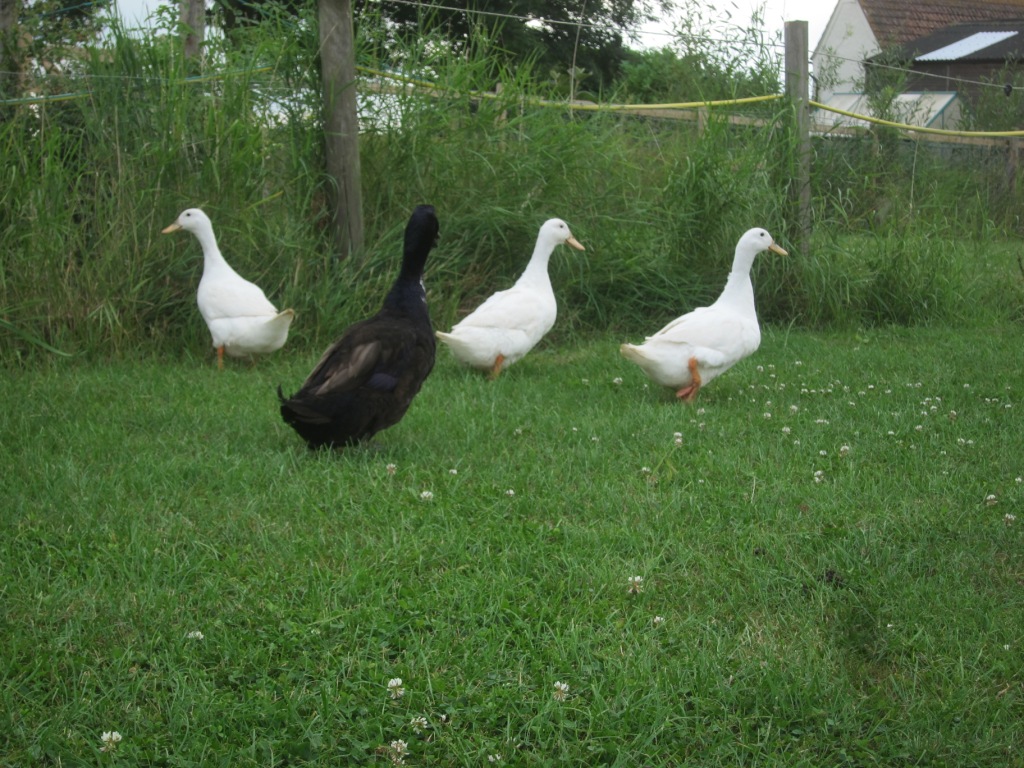
Our favourite animals are the ducks, and we now have seven wandering around clearing up the slugs in the veg patch. For yesterday we collected three white girls from a fellow smallholder who no longer wanted them.

First steps into the new home.


First contact with the Cayugas

Our drake Cayuga was very quick to hear the soft quacking of three new girls and wasted no time introducing himself. His current three girlfriends looked on in bemusement as he ditched them and spent the rest of the afternoon courting the new girls. When I say courting, there wasn't much gentlemanly behaviour going on! He (we really must give him a name) was most insistent and most persistent.


The grass is always greener!


In hot pursuit


No comment.

Thursday, 25 July 2013

To Islay and back for a Friggin' Frigatebird!


Ascension frigatebird (picture courtesy of Jim Sim)
It's not every day one of these turns up.

I've only been to Islay once before, and that was in the depths of midwinter to see the thousands of geese which flock to the island at that time of year.
But a couple of weekends ago news of an absolute MONSTER RARE had me racing Northwards for the third time in a week. Having twitched the Needletail on Harris the previous weekend and the Bridled Tern on the Farne Islands during the week, here I was again heading up the A1 aiming to catch a ferry to some far flung island early the next morning.

A somewhat indecisive and calamitous start meant that I had 5 minutes to pack and get going. I was to meet a team who were heading up the M6. Usually I would head across to Stoke, but this was not on the cards as I'd have to break the land speed record to meet the others there. Instead, an ambitious plan was hatched to meet at Carlisle. With a ferry to make in the morning from a remote stretch of shore in Argyll, the others were not hanging around and I had to make up quite a bit of time on them.
So I leapt out of gentle farm pace and into twitcher mode. To cut a long story short, and so as not to incriminate myself, I arrived at a car park in Carlisle just 5 minutes after the others. I hastily transferred cars and we headed through the night.
In the end we made it to the ferry terminal with plenty of time to spare and were delighted to be informed that there would, contrary to earlier indications, be room for our car as well as us. Several other carloads of optimistic fools were in the line too. I reckoned our chances of actually seeing the bird were low, but not as low as those who stayed at home for the weekend.

I'll cut the suspense right now and tell you that we never did set eyes on the Frigatebird. You can probably tell that from the title of this post. Having come all the way from Ascension Island (which lies roughly midway between the horn of South America and Africa) it had landed up here, sat on the harbour wall in a tiny town called Bowmore on the island of Islay. But it wasn't there when we got there. We didn't really expect it to be. After all, we knew it had flown off, harassed by the local gulls, some 24 hours earlier. However, birds are creatures of habit and there was just the tiniest hope that it might decide to return to this remote village. Or even that it might be soaring over the island. Frigatebirds are difficult birds to miss, absolutely huge, prehistoric creatures.


The very pier where the Ascension Frigatebird chose to alight.
The first time one of these birds has been seen in Britain for 60 years!

Optimistic twitchers scan the horizon for a miracle.
However, it was worth a go. And we had a most enjoyable weekend on Islay. I enjoyed my best ever views of Corncrake and a great view of a perched Golden Eagle. The scenery was stunning, the people were friendly and, at the end of the day, we came back from our mini adventure better off than when we left. Much as I love my life on the Fens, there is something very enriching about spending time on an island such as Islay.
It's not just about seeing the bird.
Twitching takes me to some fantastic corners of the country.
I wonder what my next twitching adventure will be. Hopefully there'll be a Blue-cheeked Bee-eater involved.

Tuesday, 23 July 2013

Feelin' Hot Hot Hot.


Finally a proper summer. Yesterday, after a couple of cloudy ones, it was into the 30s here. It must be two weeks of hot weather we've had now and the temperatures just seem to keep cranking up. Occasionally we get the benefit of an east coast breeze or some North Sea cloud cover, but often as not the sky's been solid blue from morning till night. And I love it!

But it's not without its challenges. Keeping the animals amply watered takes longer than usual, and we're having to use metered tap water as the water butts ran dry long ago. Most of the vegetables and flowers are well enough established to have sent their roots down far enough to find moisture, but the cracks are opening up and we could do with some rain to swell the crops. The young plants I need to get in the ground are having to wait too. It's like a desert out there.

In fact, one muggy sleepless night last week I got up at 3:20am, watered the last four empty veg beds and filled them with young brassica plants and nasturtiums.

But I mustn't moan. Not after last year.

So, instead, here's a few pics of how the piglets keep cool. (These were taken last week. Two have gone off now. But, as you can see, they had a pretty decent life while they were here.)


Monday, 22 July 2013

Whaplode Drove Country Fayre


Vintage tractors complete with the characters that own them.
Convoys of these often pass the farm on the way to and from weekend shows.
Yesterday was the Whaplode Drove (once featured on Escape To The Country or some such show) Country Fayre. And fair play to the organisers. The show only started two years ago and is already an event to look forward to each year. What's more, it's free. You don't get much for free these days.

Sue and I had volunteered to help with the Smallholders Club stall, but first thing in the morning we had another job to do, for two rather big piglets had slept in the trailer and were due in at the abattoir between 8 and 9am. There was the small matter of putting in their ear tags first. This is usually no problem at all and, with the distraction of a little food, they never even seem to notice.
But not today! I don't know why, but these two pigs were just not having it. Every time I even lightly touched their ears, my action was greeted with a loud bark and a snap. I'm guessing the piglet's ears may well have been a little sore with sunburn.
Anyway, eventually each piglet had a metal ear tag just about hanging on to its ear and we were off. The abattoir was nice and quiet this morning, just one small trailer ahead of us with one sheep. That was good news, for reversing the trailer in front of a queue of experienced trailer towers is always a little daunting. Follow this with the stress of trying to get two stubborn pigs out of the trailer which they so steadfastly refused to enter the night before and the whole thing becomes something which fills me with anxiety.

Fortunately my favourite stockman was on hand to help. He gave me enough respect to let me have a go, but when my best efforts were met with total immovability, he stepped in and expertly lifted them by the back end so they had no choice but to virtually fall forwards. He then gently ushered them into the pen where they would spend their last day.
We waved goodbye and headed to the Country Fayre. This sounds a bit casual, but we are very conscious that we are taking an animal's life for its meat. Many people ask us how we can do this, which I find rather irritating. For most of these people would prefer to stick their head in the sand and not think about how their meat was reared, though they have all the information they need to suspect that mass produced cheap meat has some rather unsavoury hidden costs. And for the most part they have been conditioned to accept a very poor substitute for properly reared meat. Rant over!

We helped out as best we could as the stall, complete with goats, goslings and chickens and chicks, was set up. The club is still officially known as the Fenland Goatkeepers and Smallholders Club, but the Goatkeepers bit is somewhat a relic of the past. Don't get me wrong, several members still keep goats, but far fewer than keep pigs, chickens, ducks or even sheep.
The club stand was busy all day.
Most of the interest in our stall was from young families with children enthralled by the animals. Some were more wary than others, with one particular toddler most insistent on climbing in the cage with the goslings!

The animals were most popular with the kids.

It was good to see quite a few faces who we knew: our bee buddy, Elaine; our local swarm collector, who had a stall which we managed to completely miss; people from Sue's school; our neighbours; people who had bought pigs from us in the past.
In fact, we seem to know more people up here, with Fenland's rather thinly scattered population, than we did in London with its masses of people crammed in.
A most informative and interesting chat
with an old timer.
The show had everything you'd expect. Vintage vehicles, rides, music, craft stalls and hog roast.
Sadly, I missed the jelly throwing competition.


Skiffle band performing 'House of the Rising Sun'
Roll on next year. Maybe see you there.

Sunday, 21 July 2013

A Swarm Captured

Any guesses how many bees in this cluster?
Somehow every swarm event seems to happen when Sue is unavailable. Last time it was when I witnessed a cloud of our bees heading off over the veg patch, over the road and spooking a herd of cows as they disappeared over the fields.

And so it was that, late afternoon a couple of weeks ago, I found myself stalking the Little Owls. For an adult was sitting right out in the open and I could clearly hear its young calling from somewhere round the old, hollow ash tree. I kept moving around the base of the tree, trying to work out precisely where the begging calls were emanating from, when something else caught my eye.

There, on the fence, was a beard! A beard of bees. Not a huge swarm, but still an impressive cluster of bees loyally surrounding and protecting their queen.

I rushed inside to get the camera, the bee suit, the bee brush and the key to the garage where, somewhere, there was stored an old nucleus box in which our first ever bees had been delivered. ( A nucleus is five frames of bees, including a young queen and new brood. This is how you buy bees if you can't find a nice bee-keeper to give you a swarm. But it doesn't come cheap, running in at up to £240!)

I didn't know what to do first. If these were our bees, they have a habit of moving on very quickly indeed.
But they just might be a swarm from elsewhere. Whatever the case, they would be sending out scouts to find a suitable new home.

Now, theory goes that when the bees are swarming they are at their most peaceful, having gorged on honey to prepare for their journey and intent on protecting their queen, without whom their attempt at colonisation would be futile.
The "nuke (nucleus) box" - a suitable temporary home for the swarm.
So, suited up in my spaceman gear, I approached the beard. First I trimmed some of the long grass to clear the way. Some of the bees dripped off the cluster as I did so.
I eased the box into position underneath them, then took the plunge, sweeping them decisively off the fence. It worked!
Almost all the bees were now in the box.
But a few were left on the fence. Those which had fallen off the bottom of the cluster plus others appearing from nowhere - maybe scouts returning. They were clearly attracted back to the same place on the fence, presumably by the queen pheromones. I scooped as many as I could into the box, keen to collect as many bees as possible, not just to make the new colony stronger but also to make absolutely sure I'd not somehow missed the queen. She should have been in the middle of that cluster and was hopefully now exploring the frames of foundation wax I'd placed in the collection box.

The stragglers were attracted back to the very same spot on the fence.
But my lack of knowledge was making me worry. What if the returning scouts came back and led the swarm elsewhere? Anyway, I'd done all I could. I sealed the bees in until Sue got home from her evening meeting at school.  

While I had the bee suit on and the camera to hand,  I took the chance to take a few more piccies.


I quickly looked in the existing two hives but wasn't sure whether this new swarm had come from either of them. For both hives had been closed down for a couple of weeks since the first swarm. I studied the pictures on the camera and the new swarm looked very similar to those in the other hives. My guess was that this could be a cast swarm, a secondary swarm following a main swarm, during which a virgin queen splits the already depleted hive.

I had done all I could. Sue arrived home much later and gave the hives a quick inspection but was unable to come to any more solid conclusions than I.

Sue inspects the hives.


It didn't seem that the swarm had come from this hive... probably

So, from one very strong colony of bees not long ago, we now had possibly three hives, not forgetting that large cloud of bees which had deserted. This meant that our bees may well be very thinly spread, if we even had any queens in  the hives.
That evening we opened up the small entrance to the nucleus box so that the new bees could go out and explore first thing in the morning. Hopefully they would take to their new home and stay, but it was very possible that they would all debunk.

This sudden escalation to three hives made an emergency trip to Thorne's necessary as we would need another hive, plus a spare in case of another swarm. I got home and set about assembling the hives and building the frames. For any beekeepers reading, we have opted for a 14 x 12 brood box. This is extra deep and gives more room for the brood, rather than using brood and a half. We'll give it a try and see how it goes.


These are extra deep 14 x 12" frames for the brood box.
Assembling new hives and all the frames to go inside is a job I love doing, but it's very time consuming. I don't usually mind as I become absorbed in the task. I couldn't finish everything that first night, despite working till very late, but the bees could stay in their temporary home for one more day to get used to their surroundings.
So, after work the next day, I would finish the job and we would transfer the bees to their shiny new cedar home.

Well, that was the plan... until the mega went off.

ASCENSION FRIGATEBIRD, Islay.

The only previous record of this bird species in the UK was in 1953, a moribund bird which ended up in a museum. And it wasn't correctly identified as such until about 50 years after it was collected.
Now, 60 years later, there was another, photographed by tourists that morning sitting on the wall of the small harbour.

This was more than MEGA. It was MONSTER RARE.

All other plans paled into insignificance as my admittedly occasionally odd priorities suddenly changed.

By late evening I was heading towards Carlisle, racing to meet up with a team from the south who were heading up the M6. We had a ferry to catch in the morning.

My second trip to the Hebrides in as many weekends, with a short jaunt to the Farne Islands sandwiched in between during the week.
As if there weren't enough to keep me busy on the farm, late June and July were not keeping to their normal reputation as being the quiet time of the year for rare bird arrivals.


Looking Back - Featured post

ONE THOUSAND BLOG POSTS IN PICTURES

Ten years and a thousand blog posts! Enjoy. Pictures in no particular order.  

Related Posts Plugin for WordPress, Blogger...