Thursday, 13 September 2012

Home-reared pork and sausages now available!

Daisy and the girls. The boys are all gone now.
Thursday 13th September 2012

Last week we took the two young boars off in a trailer and this today they came back in a couple of cardboard boxes.
How to fit two pigs in the back of a car!
They weighed in at 37kg and 38.9kg. Pretty small, but I expected that given that they are a mix of traditional, slow-growing breeds and they had to go off at just under six months old to avoid boar taint.
I am pleased with the meat though. Not too much fat at all, but enough to give it succulence and moisture.
This is how the meat comes back from the butcher.
All I have to do is price it up and put it in the freezer.
I have used a new butcher this time around, Tan Rose in Parson Drove, and they have made a very careful job of their work. I have also gone for smaller joints and packs of meat as most of my customers are couples for whom a large lump of meat is just too much.

Tonight we'll be eating fresh liver, a lovely part of the pig all the better for being fresh. I can't wait to try the sausages too. Maybe for breakfast tomorrow.

And if anybody local wants to try some too, just pop in to the farm.
Here's our pricelist.


Swallow Farm
Home-reared
Pork & Sausages

Now available in smaller packs and joints , ideal for two.

Price List

Whole Pig £4.50 /kg (40-50kg)      Half pig £5 /kg (20-25kg)          Quarter Pig  £5.50 /kg


******  Traditional Sausages ******

£3.60 per pack of 8


********* Pork chops (packs of 2 chops) *********

only £2


***** Pork Shoulder (crop or hand ******

Joints from £3.60 - £6       


************* Pork Belly & ribs ***************

From just £2.50 to £3.80


********** Leg joints ***********

£6 - £9 each

_________________________________________


Wednesday, 12 September 2012

Thirteen keets

Tuesday 11th September 2012
Wednesday 12th September 2012


I am just about recovered from a long, long weekend away on the Hebrides. Yesterday morning the Spotted Flycatcher was still making aerial forays from the ash trees. They swoop out and back in a characteristic loop, plucking some small insect from the air along the way. However, I've not been able to relocate it since. While looking for it later in the roadside hedge, which is full of red hawthorns and dark elderberries now, a chiffchaff, a whitethroat and a blackcap appeared at various points though so birds are clearly on the move through the farm.

Sad news today as, on return from work, I could only count thirteen guineafowl chicks in the wet grass with their parents. The chicks have been getting more and more independent, but this has led them into more dangerous situations. Unfortunately I found the missing one drowned in the ducks' pool. It must have clambered up onto the pallet which acts as a ramp and couldn't get out once it fell in the water.

On a more cheery note, Don harvested his maincrop spuds last week and gave me a barrowload of rejects for the pigs. However, I have discovered that the geese are quite partial to them too, so the pigs now have to share.


Tuesday, 11 September 2012

To South Uist to see a Semipalmated Plover


The subject of our quest

There are some people who would find it an effort just to walk the 300 metres from my farmhouse to the end of my land, but a Bar-tailed Godwit has just been clocked flying 7258 miles non stop.
The Short-billed Dowitcher which I drove to Dorset to see last week had travelled here all the way from East coast America, at the tender age of a few months old and without its mum and dad!

But on Friday morning news came through of another transatlantic vagrant to make it across the ocean. This time a Semipalmated Plover had pitched up on a beach in South Uist, one of the chain of islands which run down the West coast of Scotland known as the Outer Hebrides.
This was to be the weekend for getting out the tractor and cutting the meadow, but that plan was hurriedly ditched. That job can hopefully wait whereas the bird might move on at any time.

So a crazy plan was set in motion which had me leaving my house at 9 on Friday evening and arriving, via Uttoxeter to pick up a friend, at Oban ferry terminal 465 miles and 8 hours later. We joined the sleepy line of vehicles waiting to be directed into the right lanes for the ferry boarding, only to find that this was the queue for the ferry to a different island and we could not queue for ours until 7am! The good thing about arriving at this time though was that we received some valuable advice to buy a ticket for the ferry. I had assumed that they virtually never filled up, but was informed otherwise. In fact we were unable to book the ferry back off the islands on Sunday morning, having instead to come off on Sunday evening. This was not terrible news, as it gave us longer to enjoy a beautiful set of islands and I did not have to be at work on Monday.

Being on the west coast and in a small town flanked on one side by sea and the other by mountains shrouded in a dull, drizzly mist, sunrise didn't really happen, but here's a general view out across the harbour taken when the sun should have been rising.

Saturday 8th September 2012
Not the Fens!
On the crossing we were lucky enough to see two adult White-tailed Eagles on the rocks with a young bird. As we sailed past these true giants took off and started fishing, swooping down on some poor fish just below the surface. Their quarry was pretty big as even at distance through the binoculars I could see it jumping out of the water in its effort to evade capture. It looked about the size of a small porpoise. I took a few scenery pics as we chugged along the channel between Mull and the mainland.


Once out to sea our journey was punctuated by two meals on board ship and a couple of hours catching up with sleep. There was still time for some seabirds though and we saw several groups of Storm Petrels, tiny black birds with white rumps, feeding on the surface of the sea. They look as if they would get blown into the sea by the slightest gust and swallowed up by the waves, but they are unbelievably hardy little creatures.

At 1:30 in the afternoon we disembarked at Lochboisdale and headed along the single track roads of South Uist to the south end of the island, taking the turning just before the causeway to Eriskay. After a short distance we saw a car pulled up by the side of the road. There was not much reason to be here other than for the birds and indeed we were lucky enough to be greeted by the finder of the bird, a very helpful man who had retired to the islands about six years ago. Not only did he give us a good description of where to go to find the bird, but he led us over the boggy hill and down onto the rocky beach and helped us locate it.


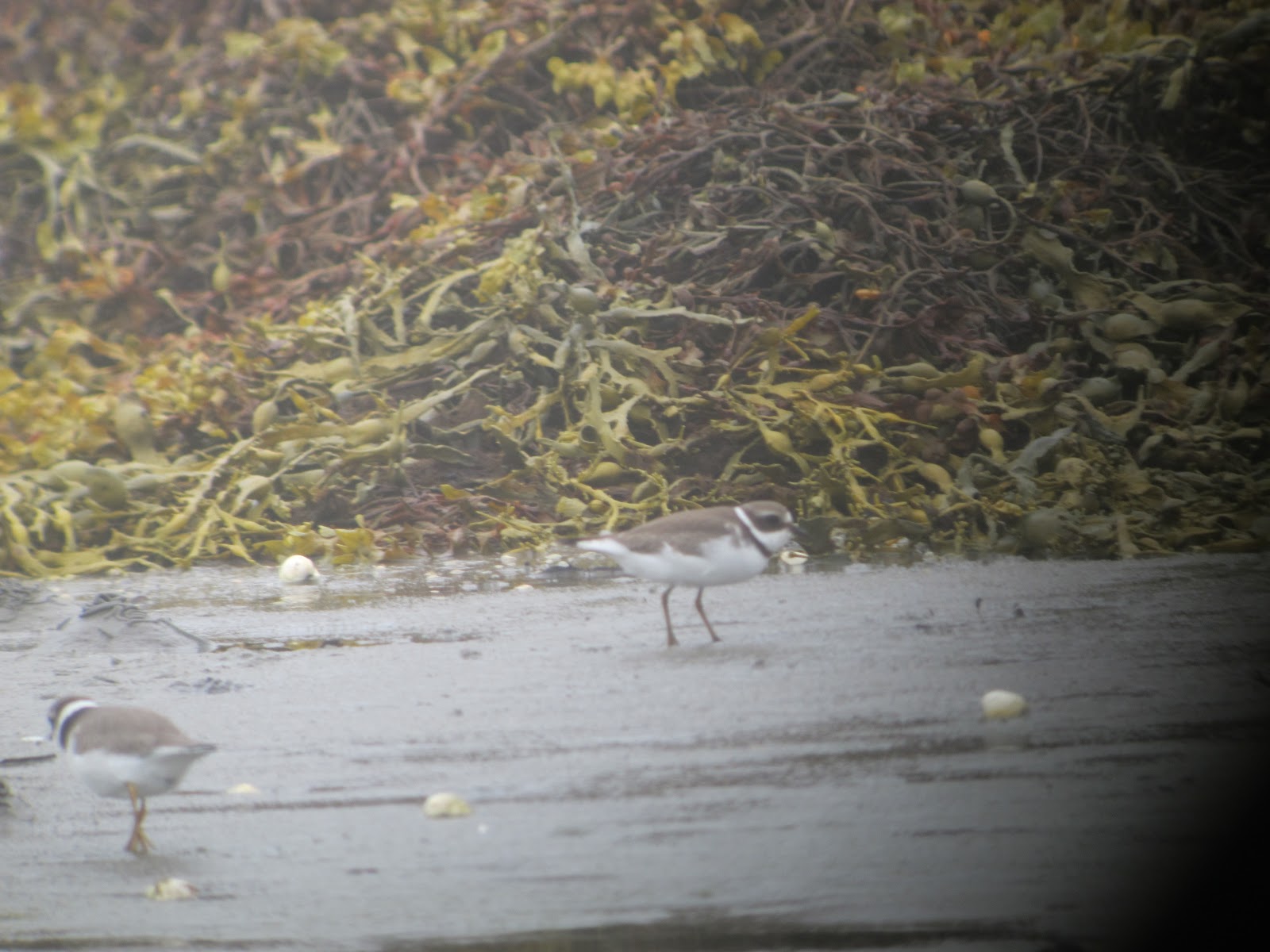
It was a tense 20 minutes or so before we managed to pick it out amongst the gangs of Ringed Plovers, its equivalent on this side of the Atlantic.


All the way from America, a Semipalmated Plover.
See how similar it is to the other bird in the pic, a Ringed Plover.
After 500 miles of driving and a 5 hour boat journey, we had caught up with our quarry. We didn't catch it, pursue it or harm it. We just enjoyed watching it on a wild and remote beach on a stunning island.

The rest of the day was spent trudging up and down beaches and across machair, that special Hebridean plantscape, searching for more transatlantic vagrants. Though not so rare, we did manage to locate a Buff-breasted Sandpiper and two Pectoral Sandpipers, all young birds blown across the Atlantic and dumped here in this unfamiliar setting.

Then began our final search of the day. Somewhere to stay. With phone reception patchy, to say the least, modern technology was not a lot of help, but we eventually came across a sign for the Orosay Inn and booked ourselves in for the night. The Seafood pie was amazing and the beer was good.
But nothing prepared us for the breakfast, the largest plateful of food I've ever had put in front of me. There was nothing that might go into a full breakfast that wasn't on this plate!


Crazy breakfast for a crazy birder.
And before you wonder, yes I did get up to take a sunrise photo, but it wasn't at all clear where the sun was supposed to be rising, as the sky was ominously dark. Anyway, here's where I think it was!

Sunday 9th September 2012
Still not the Fens!
As you can imagine, breakfast took quite some time to polish off, but it was needed for we did a lot of walking today in some pretty challenging conditions. We trudged along seaweed strewn beaches, crossed miles of sandy beaches and bays. We battled the wind to reach rocky headlands and scoured machair and the recently cut hay fields just inland.


It was a very good day though as we first relocated a diminutive little bird called a Semipalmated Sandpiper (only the fourth I've ever seen) feeding on the shoreline miles out on a flat, sandy beach. We drove rutted, sandy tracks to skirt along the coast and took shelter behind some of the agricultural machinery being used for haymaking. As we scanned a skittish flock of Golden Plovers we found two of their American relatives (surprisingly known as American Golden Plovers) and another three Pectoral Sandpipers. Five birds from across the Atlantic, all in one field. Absolutely amazing!

And a double treat for me, as a smallholder, to see how the Hebrideans harvest their hay, still using machinery but on a scale more akin to my own meadow. I now want a small baler or, preferably, a buncher which leaves the hay in traditional little hayricks. I also admired a whole host of trailers, gates and other agricultural devices. I can see myself being part of this scene one day.

By early afternoon the drizzle had developed into a solid sheet of fine rain which soaked everything it touched. We continued birding, but mostly from the car, before heading for our evening ferry. A shorter journey on the boat where I took advantage of a couple of hours nap time before the overnight drive back to Lincolnshire. Such a shame to miss the dramatic scenery of Skye and Glencoe on the way back.
By 9 o'clock on Monday morning I was sitting in a traffic jam on the outskirts of Nottingham. What a comedown.

And by half past ten I was pulling in to the familiar setting of my farm. And you'll never guess what!
After 1278 miles, there, perched on the gutter at the corner of my stables, was a Spotted Flycatcher, only the second I have recorded on the farm, and the first had been a major surprise.

Funny old game, birding.


Friday, 7 September 2012

All quiet in the stables - the swallows depart

Friday 7th September 2012
The start of another fine day.
After a very slow start, summer has stayed late this year.


The fence I've been constructing to mark the end of the garden.
I love the way it seems to organise the view
and makes a feature of the oldest of the Ash trees.

Every spring I look forward to that day when I open the stable doors and the first swallow swoops out past my ear. From then till the beginning of September there is a constant chattering in the stables, especially as I walk past first thing. But three days ago all went quiet. No longer are families of swallows swooping over the veg patch in the morning or perching on the wires. For, en masse, they have gone, away on their incredible journey back to Africa. And with them has gone the hobby which spent four days harassing them last week. You could always tell when it was around by the crescendo of angry twittering and the posse of adult swallows that went up to bravely confront it.
Despite many sightings each year, I've still to see a hobby actually take a swallow, but there are plenty of dragonflies around on the farm this year to stave off the hunger.

It's not often I recommend a book, as regrettably reading is not a pastime that I've spent much time on over the years, but my favourite author, discovered in my teacher role, is Michael Morpurgo, a prolific writer of children's books which are equally readable by adults.

The reason I mention this? In his book, Dear Olly, three separate stories are cleverly woven into one. One of those stories concerns itself with a swallow's migration from leafy Britain to tropical Africa, told from the swallow's point of view. There's an evil, shadowy hobby which looms over the flock on their journey.
Well worth a read.

The departure of the swallows does leave a certain emptiness in the stables and over the fields, but it paves the way for a new season, an exciting time for me as a birder. It's all change. Apart from the familiar resident birds, all the summer visitors will depart and a whole host of wintering species will appear. Marsh Harriers will be replaced by Hen Harriers, flocks of waders and ducks will wheel about in the air, finches and larks will mass together. And in the change over, a few birds will get lost and some, the rarest vagrants to these shores, will achieve celebrity status attracting hoards of obsessive twitchers to pay homage to them. And I will be there!
Meanwhile, I am just very happy that a Snipe has taken up temporary residence in the dyke at the bottom of my land.


Thursday, 6 September 2012

Fourteen Keets

Thursday 6th September 2012
This morning I flushed a Snipe from the dyke.
A good start to the day.

Yesterday morning a weasel bounced across my path as I walked back from letting the chickens out. This was a most welcome sight as we've not seen one for quite a few months, not since Gerry caught one. But it was also slightly worrying news for the keets. Although the guineas defend their young robustly, they can't keep an eye on all of them all the time and the weasel is a pretty nippy little fellow.


When I returned yesterday, Sue told me she could only count fourteen keets. Whether this was down to the weasel or not, I don't know. I suspect not. It was only the other day that one became separated from the rest of its family and would surely have perished had I not heard it in the long grass of the orchard and reunited it.


If it was indeed the weasel which took one of the keets I reckon it will return, so I've made the decision that if numbers go down much further we will be back to indoor rearing for a while.
As it is, fourteen is still a very good sized family to have survived this long.

They now spend much of their time in the chicken pen. They have joined the trribe of lder chickens, but the younger chickens are still driven off with vigour. In the evening the keets go through the fence to their separate house and Lady Guinea hops over to join them. G'nea G'nea roosts on the fence as lookout.

Meanwhile, I have put ten eggs under Elvis, which she has now been on for three days. Let's hope she gets to be a mother this time and that she has ten hens.


Wednesday, 5 September 2012

Short-billed Dowitcher in Dorset

At just before midnight last night my pager started wailing and my phone vibrating.
MEGA!!!

New photos published late established the identity of the Dowitcher down in Dorset. Trouble was, it hadn't been seen all afternoon yesterday and was clearly very elusive.
I almost drove down to Weymouth there and then, but decided to wait for news in the morning. A few years ago I would definitely have been on my way at midnight!

Wednesday 5th September 2012
Happy birthday Mum!

As the sun rose, I still didn't know if I was heading for Dorset today.

By 7:30 the bird's continued presence was confirmed, and I was still on the farm over four hours away. I decided to play it cool, feed the animals and prepare myself for the journey.

By 11 o'clock I was here...

Parked on the M25 - the old stomping ground.
Couldn't be much different to where we are now.

Sitting on the good old M25! The bird hadn't been seen since just before 8 and I still had half my journey to go. It was begining to feel like an act of desperation. If the bird didn't play ball, I would be doing the same route overnight on Friday for another go. But I have a saying. Never turn back from a lifer, so on I went down the M3 and along the South coast, finally pitching up at just gone 1 o'clock, some 5 hours since the bird had last been seen. I was due back in Holbeach St John's at 7 for a talk on the archaeology of the area. This was of real interest to me, as we live on the site of old Roman salt workings. I was unlikely to make this now. Sue would have to attend on her own. She is very understanding when it comes to my birding!

It's a strange old hobby, twitching. Every few months or so you meet a group of friends and acquaintances from across the country. You don't know where or when it will be until it happens. And so I pulled up in the car park just behind an Essex birder I know who, within a couple of minutes, received a phone call that the bird had just been seen. Panic! Run around like a headless chicken trying to find which way to go. Meet other headless chickens. All follow each other. Until we got here...


The bird was, apparently, skulking around in those sedges just across the first patch of water.
It doesn't always happen, but I do have a rather annoying habit of turning up just as long absent birds reappear. Within fifteen minutes the pressure was off. I had seen the bird well enough to get all the ID clinchers. Further patience as it gave occasional, fleeting views through a small gap in the vegetation, but eventually it did come out into the open in good late afternoon light. I'm not equipped with the right gear for taking piccies of birds, but I tried putting the camera up to the scope and I did get this...

It's the bird at the back,
a Short-billed Dowitcher!
Under the water is, in fact, a pretty long bill.
But the key ID features are at the other end of the bird.
Four and a half hours later I was back on my fenland smallholding. Mission accomplished. 

Tuesday, 4 September 2012

The kneeling sheep

Tuesday 4th September 2012


At first light this morning, this mother roe deer and her fawn allowed me remarkable close approach. Fortunately a large clump of grass hid my approach along the dyke and the wind was blowing freshly. They were taking a morning drink, but when they saw me they went bouncing off over the fields. Do they have supersprings in their hooves?


Bird news from the night before of a possible Short-billed Dowtcher in Weymouth had me on tenterhooks all day. To go would be a bit of a risk as it's identity was far from sure and a four and a half hour journey each way needed a bit more of a guaranteed result at the end of it. I'd seen one before, over in Ireland, but this bird would be only the second ever in Britain and I didn't see the first back in 1999.

But there was birding to be had on the smallholding today with the appearance of not one, not two but three smart male blackcaps around the pond, along with a chiffchaff. These birds came in overnight for sure. It is amazing how we get these mini falls of birds here. I am sure they must travel in small groups.

Anyway, on to the subject of this post, the kneeling sheep. Our two lovely Zwartbles came from an organic farm, but sadly a few of the sheep were long overdue a hoof trim. We had done this when we picked them up, but Number Ten's hooves were in a right state. We had treated them with antiseptic spray again, but by this morning he was clearly in some discomfort, preferring to kneel rather than stand and limping slightly when he did walk.

So we captured him and spent a good half hour tidying up his hooves. I must say, I think I did an expert job. Let's hope it works and Number Ten appreciates it, as my leg muscles are now very sore from gripping on to a wriggling sheep for so long. So far he doesn't seem to be holding it against us and, if anything, is friendler than before.
I'm not sure who is grimacing more for the camera!


Monday, 3 September 2012

Scarecrows invade gory Gorefield

Monday 3rd September 2012
Every year the nearby village of Gorefield holds a scarecrow competition and this year the theme was the Olympics. We couldn't explore the whole village as we had a trailer on the back of the car, but here's a selection of some of the creations which lurk over the hedges and in the front gardens of the village.


If you want to see them, you'll have to be quick. They are on display until 9th September. For details of next year's show, and other Gorefield village news, visit their parish website at http://www.gorefield.com/info/scarecrow.html

And the reason we were in Gorefield? ... Well, with a name like that it should come as no surprise that this is the location of our local abattoir! And today the two boars were off to meet their maker. Already settled into the trailer, dropping them off went pretty smoothly.  Once off their home turf, pigs are remarkable timid creatures, stubbornly sticking in the trailer which has become their temporary home. But the staff on hand handle livestock every day so soon get them moving down the ramp and into their allotted stall.

The abattoir in Gorefield is in a quite bizaar location, right in the middle of the village and bang on the doorstep of the children's playground. Apparently you can often hear the squealing pigs above the squealing children, and it's not unusual for an escapee to be running around the streets with owners in hot pursuit (pigs, not children).


Amazingly, the trailer behind us in the queue held their three brothers, which we'd sold to a local smallholder four months ago. I guess, being boys, they had to go off at pretty much the same time, before their half a year birthday. They were much fatter than ours!! That's OK unless they've simply been turning all that expensive food into too much fat. A healthy layer of fat is crucial for the flavour of slow-grown, traditional pork, but several inches is not good. It will be interesting to see what the meat comes back like.

We are trying a different butcher for our meet this time, as the previous one was further away and seemed to have put their trainee onto our pigs with a blunt axe!


Say GOODBYE!
The day a pig gets earrings is not good news for the pig!

Looking Back - Featured post

ONE THOUSAND BLOG POSTS IN PICTURES

Ten years and a thousand blog posts! Enjoy. Pictures in no particular order.  

Related Posts Plugin for WordPress, Blogger...